Functioning at the Expense of Feeling
High achievers are everywhere.
They come in many forms. We often think of the high-powered executive, the doctor, the lawyer, etc., but high-achieving lives just as fully in the person who devotes their life to caregiving, or the person in the middle of reinvention. It’s not necessarily a position but rather a personality type. And when we see these people, it feels like they hold it all together effortlessly. You may be a high achiever too, but the difference between how you perceive yourself versus how you perceive others is that you think you are barely keeping it together.
On the outside, you look just like them, but on the inside, you are just surviving.
What does high functioning but not thriving look like? It looks like functioning at the expense of feeling, like making decisions logically while quietly wondering if it’s actually what you want. It’s not being able to name what you feel beyond tired or stressed. Or always being on, unable to rest without reaching for the phone, the TV, or the next task. And when someone asks you, “How are you doing?” and you respond, “I’m fine, just busy.”
Most high-achieving people are not struggling in obvious ways.
They are competent, responsible, and very capable. But over time, the adaptations that helped them succeed can quietly become armor that builds slowly, often without their awareness. It is built from the expectations we carry, the emotions we learn to suppress, and the strength we believe we must always maintain.
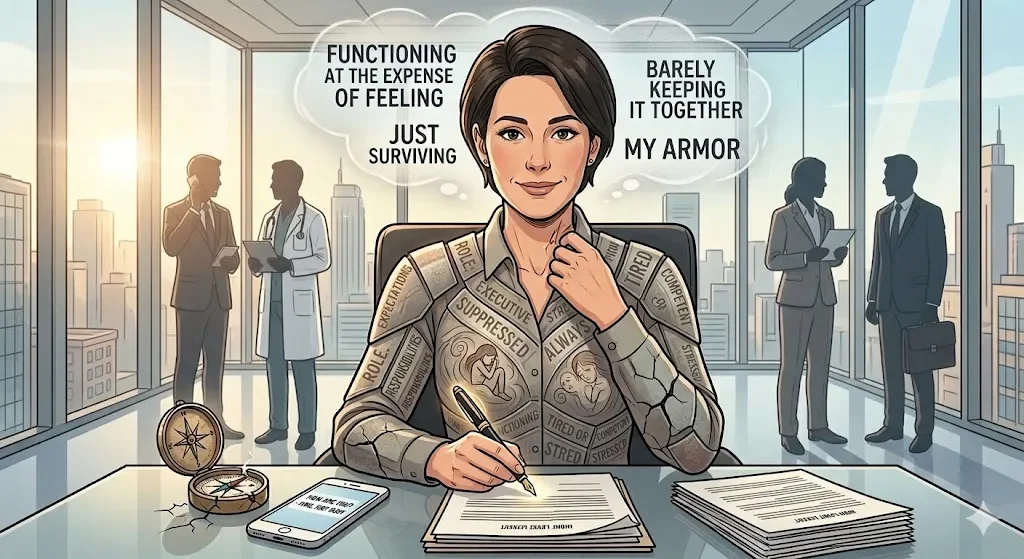
I recently learned about Wilhelm Reich, a psychiatrist who studied under Freud in the 1930’s and proposed the concept of character armoring, which describes the protective patterns we build to survive and succeed. These patterns develop for good reason. They allow us to function under pressure, manage expectations, and remain composed in the face of difficulty. This armoring supports competence, resilience, and outward success.
But what happens when the armor we built over time outlives its purpose, when it is no longer needed for protection?
Most continue to perform well, but the effects, while subtle, are cumulative. Armor is heavy; it takes energy to maintain. The more armor you have, the more effort that is required to maintain it, resulting in fatigue that rest does not fix, feeling tired but wired, needing constant stimulation to stay energized. Because so much energy is devoted to maintaining that armor, we learn to neglect or restrict certain emotional experiences, which, over time, leads to greater disconnection from ourselves and others. This is how we mostly live in the “head space”, with decreased awareness of physical experiences, leading to difficulty recognizing early signs of stress or overwhelm until the body is already beyond the point of early warning. But the most significant cost is losing contact with one’s own internal compass. When life revolves around expectations, responsibilities, and roles, we can lose access to what feels genuinely ours, and that is when we begin to say, “My life looks successful, but why do I feel disconnected from it?”
That is exactly what I asked myself several years ago when I had reached a crossroad in my life.
I was a practicing physician for over 20 years in a high-stakes environment and served as the department head, with many administrative responsibilities. I was married to a fellow physician and the mother of three teenagers. I appeared put together, accomplished, and respected. I was. But inwardly, I didn’t know how much longer I could keep doing all of this. I felt I had to appear strong. I didn’t want to appear weak, especially in the face of so many others appearing to do it all without difficulty. The armor I didn’t know I was carrying stayed, slowly growing heavier as I kept going. And then, suddenly and unexpectedly, my husband died. So, on top of all my existing roles and responsibilities, I now had to solely take on my husband’s private medical practice, which I had no experience with, worry about my 3 grieving children in such formative years, while tending to my own grief on such unsteady ground. I continued doing all of it for almost two years, but the armor was becoming too heavy, and I was losing myself in the process. I made the incredibly difficult decision to step away from my career responsibilities to tend to my family and my husband’s practice. And that is when my inner work truly began. Not by design, but by a chance encounter with a coach, a few sessions that cracked something open, and eventually a conscious decision to go all in.

What did that look like for me? I didn’t know what coaching really meant.
I had met her virtually through an online course I was taking after I stepped away from my career. She could see I was struggling, and the grief beneath it all. She offered me a few sessions for free. That was the beginning. I am still in it. I began to see and understand parts of myself that were unconscious to me. There was the outer me, the one I presented to the outside world, and the inner me that I suppressed and had become almost completely disconnected from. Through that work, I developed an awareness of my protective patterns and how they had served me in my life. I began to see how being attuned to myself, my body, and my physical sensations was the greatest form of wisdom and insight for me. I could make decisions and move forward with greater clarity and more conviction. And once I could see it, I couldn’t unsee it. That is what eventually became the work.
I still hold a lot of fears, stress, and anxiety, but the difference now is I notice them much earlier, and my relationship to those fears has begun to change.
While fear still wants to run the show, I’ve realized I don’t have to let it.
I am building my capacity to carry the same fears and show up anyway in a way that is true to who I am. I don’t always get it right. I am human after all, but I know I am on the right track. What I know, more than anything else, is that I now have access to my own internal compass. For someone trained to read every signal in the room, it took me a long time to learn to read the ones coming from within. But now I make decisions that are genuinely mine, and I am more present in my own life rather than just managing it.

That leads me to my work now. I am still a part-time practicing physician, and I now work with others who see elements of themselves in this story, high-functioning, high-achieving individuals who are ready to soften their armor and find their own internal compass. Most forms of coaching focus on changing thoughts, managing emotions, or improving performance. These approaches can be helpful, but they often stay in the mind and miss the body’s quieter truth, where stress (and wisdom) first show up. I created the ARMOR Release Framework™ to help guide individuals in that process of trusting the inner self. It moves through five stages - Arrive, Regulate, Meet, Open, Renew - each one building the capacity to turn toward yourself rather than away. It is not a linear process. It is a practice of returning. It supports insight that is lived and embodied, and change that is sustainable.
The armor you developed made sense when you built it.
It kept you safe, capable, and moving forward. But you are reading this for a reason. We all have armor. Where does it show up in your life? Feel free to share below.